Digital Twin for Industrial Energy Management
-
Ongoing
 January 2026 to December 2026
 -
Project Partners
-
Alta Vision Ltd, UK (Lead)
-
The Robert Gordon University, UK
-
MetFuel, India
Alta Vision and Robert Gordon University are working together again, this time with Indian industry partner MetFuel, under Innovate UK's India-UK Collaborative R&D for Industrial Sustainability programme. The consortium is developing a digital twin that gives energy intensive factories real time visibility of their energy use, forecasts demand before it happens, and automatically balances renewable electricity against electric and LPG based heating.
The partnership builds on AR-Mini, an earlier Innovate UK project in which Alta Vision and RGU demonstrated AI controlled mini-grids for rural electrification in Sri Lanka.
Funded By
- Innovate UK: India-UK Collaborative R&D, Industrial Sustainability Round 2
Project Objectives
- Develop a real time digital twin covering the mini-grid, electric heating, and LPG based heating in one platform
- Deploy an AI managed mini-grid with solar PV and battery storage to reduce grid and diesel dependence
- Build AI models that forecast energy demand and optimize the mix between renewable electricity, electric heating, and LPG heating
- Deploy IoT sensors with an edge computing layer so control decisions run locally, without relying on internet connectivity
- Validate the system at a food manufacturing facility in Bangalore, India
- Establish a scalable model for industrial energy decarbonization across manufacturing, food processing, and materials sectors in the UK and India
Technical Overview
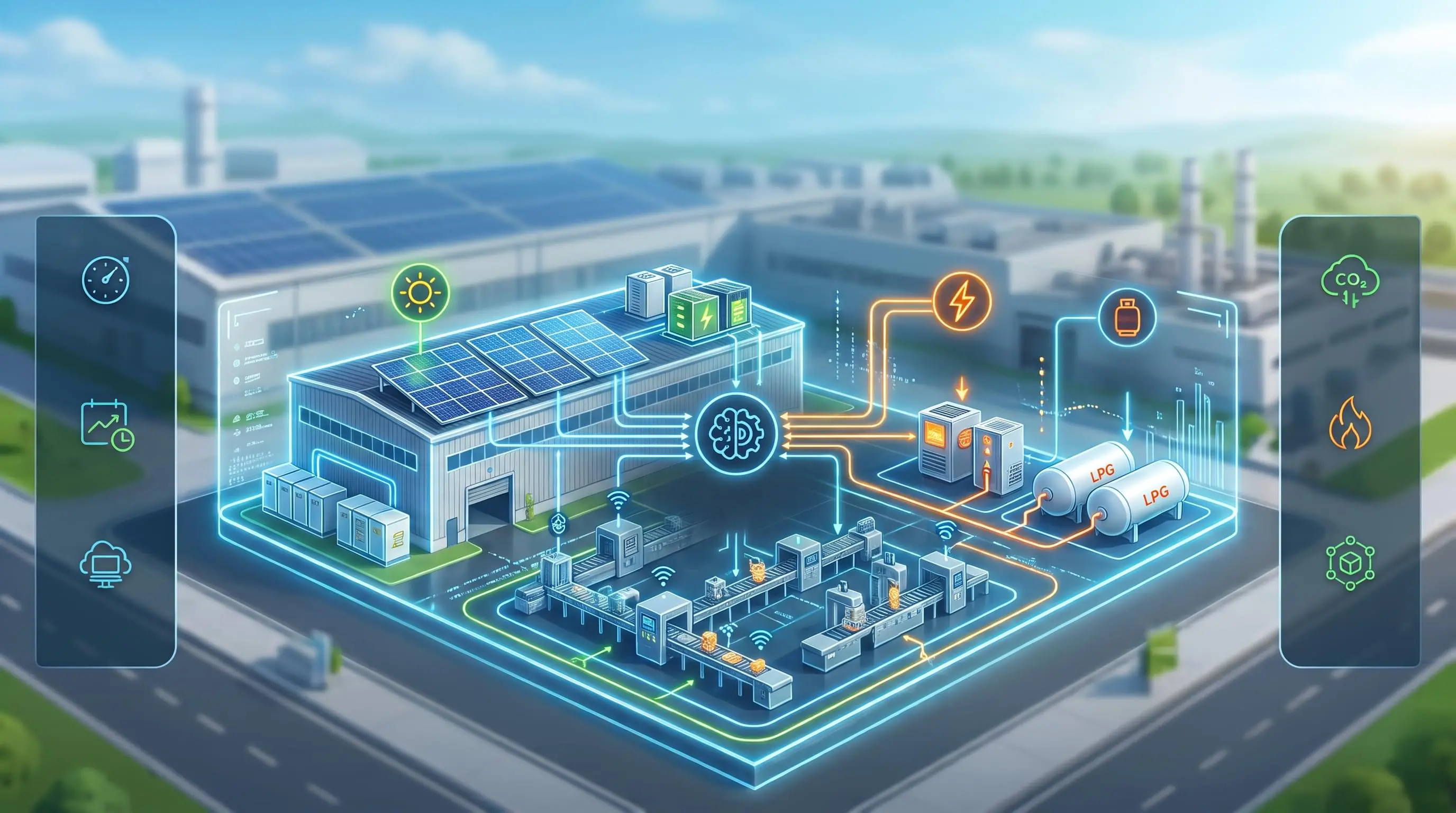
The mini-grid combines solar PV, an inverter, and battery storage, integrated with the site's existing supply. An edge device inside the facility runs control decisions locally, which matters at sites where connectivity is unreliable.
IoT sensors monitor heating units, motors, and production lines, capturing energy consumption, temperature, equipment performance, and emissions. Data is processed at the edge for immediate decisions and synced to the cloud for longer-term analysis.
The AI layer forecasts demand from historical load profiles and live sensor data, then schedules electric heating around predicted solar availability and adjusts the electric-to-LPG heating ratio based on current conditions.
The digital twin sits above all of this as a live virtual model of the factory's energy system. It runs simulations and scenario tests before changes are applied to the physical site, and maintains a blockchain backed audit trail for emissions reporting and carbon credit validation.
Expected Key Outcomes
- Up to 25% reduction in CO₂ emissions through optimized renewable energy use and AI controlled heating
- 15 to 20% reduction in capital costs by cutting battery storage requirements through AI load shifting
- Real time visibility across all factory energy flows, replacing fragmented manual monitoring
- A validated system that can be deployed commercially in comparable industrial settings
- Contribution to UK industrial decarbonization targets and India's renewable energy transition